 Librería Samer Atenea
 Kálamo Books
 Librería Elías (Asturias)
 Librería Kolima (Madrid)
 Librería Proteo (Málaga)
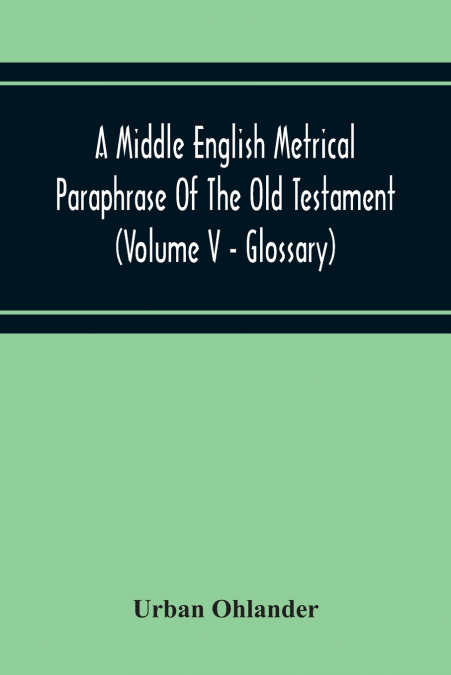
A compass for the language of medieval scripture. Every entry opens a world. Urban Ohlander’s Volume V is a finely judged glossary for the Middle English metrical paraphrase of the Old Testament: a practical lexicon that clarifies variant spellings, semantic shifts and idioms that complicate modern reading. The entries are anchored in usage, attentive to metre and to the rhetorical turns that characterise biblical poetry analysis, and they illuminate how scripture was paraphrased into the vernacular. Useful to readers beyond the specialist, the glossary supports both casual exploration of medieval christian texts and rigorous scriptural language study - students, translators and anyone interested in medieval religious literature will find pathways into text and context.Republished by Alpha Editions in a careful modern edition, this volume preserves the spirit of the original while making it effortless to enjoy today - a heritage title prepared for readers and collectors alike. The edition reasserts the work’s place within fourteenth century England studies and among Middle English manuscripts, and positions it as an indispensable historical linguistics resource for those tracing phonology, morphology and semantic change across the medieval vernacular. Practical for teaching and indispensable for philological enquiry, the glossary underpins lectures, translations and critical editions that seek authentic readings. As an old testament glossary and academic reference collection for medieval bible studies and Chaucer era literature, it furnishes the documentation and cross-references that scholars, librarians and classic-literature collectors prize. Casual readers curious about medieval religious literature will discover searchable routes into unfamiliar words; specialists will find the detailed linkage between entries invaluable. Its careful attention to form and usage makes it an ideal companion for courses in historical linguistics, medieval literature and theology. Whether consulted for a single difficult lemma or read through for its cumulative insight, this volume brings the paraphrase and its age into sharper focus. Practical, authoritative and reverent to its source, this glossary reconnects modern readers with the craft of a middle english biblical paraphrase and the living cadence of the medieval Church’s vernacular voice.