 Librería Samer Atenea
 Kálamo Books
 Librería Elías (Asturias)
 Librería Kolima (Madrid)
 Librería Proteo (Málaga)
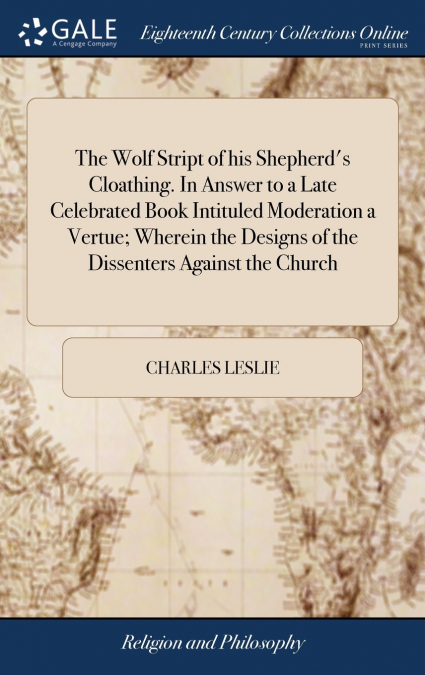
In 'A Letter From A Gentleman In Scotland To His Friend In England, Against the Sacramental Test,' Charles Leslie presents a compelling argument against the Sacramental Test, a law requiring individuals to take Holy Communion according to the Church of England in order to hold public office. This letter, penned with astute observations and fervent appeals, delves into the implications of such a test on religious freedom and societal harmony. Leslie critiques the imposition of religious conformity as a means of ensuring political loyalty, advocating for a more inclusive approach that respects individual conscience. Through reasoned discourse and historical context, Leslie challenges the prevailing norms of his time, making a case for religious tolerance that resonates even today. The letter serves as a valuable primary source for understanding the complex interplay between religion, politics, and personal liberty in 18th-century Britain. Scholars and enthusiasts of religious history, political science, and Scottish-English relations will find this a thought-provoking and enlightening read.This work has been selected by scholars as being culturally important, and is part of the knowledge base of civilization as we know it. This work was reproduced from the original artifact, and remains as true to the original work as possible. Therefore, you will see the original copyright references, library stamps (as most of these works have been housed in our most important libraries around the world), and other notations in the work.This work is in the public domain in the United States of America, and possibly other nations. Within the United States, you may freely copy and distribute this work, as no entity (individual or corporate) has a copyright on the body of the work.As a reproduction of a historical artifact, this work may contain missing or blurred pages, poor pictures, errant marks, etc. Scholars believe, and we concur, that this work is important enough to be preserved, reproduced, and made generally available to the public. We appreciate your support of the preservation process, and thank you for being an important part of keeping this knowledge alive and relevant.