 Librería Samer Atenea
 Kálamo Books
 Librería Elías (Asturias)
 Librería Kolima (Madrid)
 Librería Proteo (Málaga)
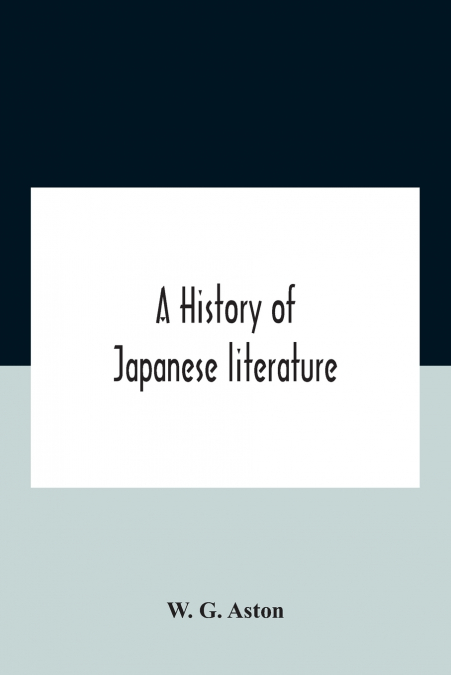
A masterful map of Japan’s literary soul. History in every resonant line. W. G. Aston’s A History of Japanese Literature remains an indispensable classic literary history, tracing early Japanese writing from court chronicles and myths through the refined registers of traditional Japanese poetry and the narrative forms that matured across the samurai era literature and into Meiji period Japan. Aston writes with philological care and cultural empathy, making complex shifts in language and taste understandable for general readers while supplying the rigour demanded by scholars of asian literary studies. More than a survey, it reads like a conversation across centuries - contextualising sources, themes and genres so that literature students resource and seasoned readers alike can follow connections between ritual, court life and the emergence of modern narrative.Republished by Alpha Editions in a careful modern edition, this volume preserves the spirit of the original while making it effortless to enjoy today - a heritage title prepared for readers and collectors alike. Its historical significance is plain: an early English-language account that gathered and explained Japan’s literary past, helping to shape later work in asian literary studies and cultural heritage analysis. Collectors assembling a japanese literature anthology, students seeking an academic reference book, and curious readers exploring Meiji period Japan or the roots of traditional Japanese poetry can find rich reward. Of interest to readers of the Oxford Oriental Series and a fine addition to any Asian classics collection, Aston’s study rewards casual browsing as much as close study, combining readable prose with scholarly backbone.Written with clarity and a scholar’s ear, Aston’s prose invites both the curious and the specialist: it is as suited to a literature students resource as it is to a personal library of rare volumes. Its clear surveys and judicious commentary make it a dependable academic reference book, while its scope from early Japanese writing to Meiji period Japan gives casual readers wide pathways into Japan’s cultural past. For anyone engaged in asian literary studies, or assembling a japanese literature anthology, Aston’s study remains a luminous guide.