
Inicio > Matemáticas y ciencia > Física > A Hidden Simplicity of Nuclear Particles
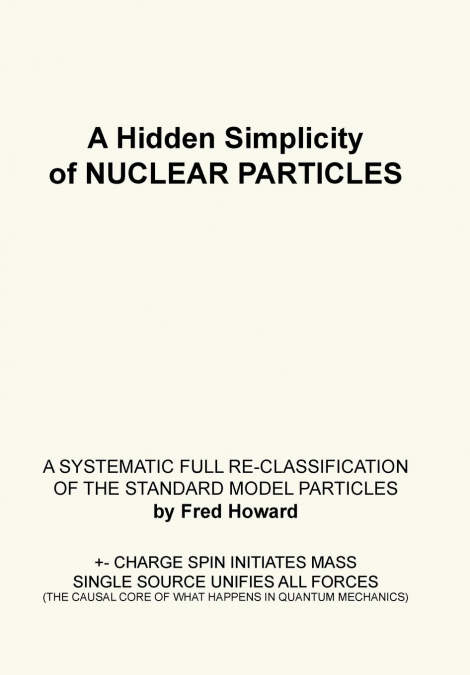
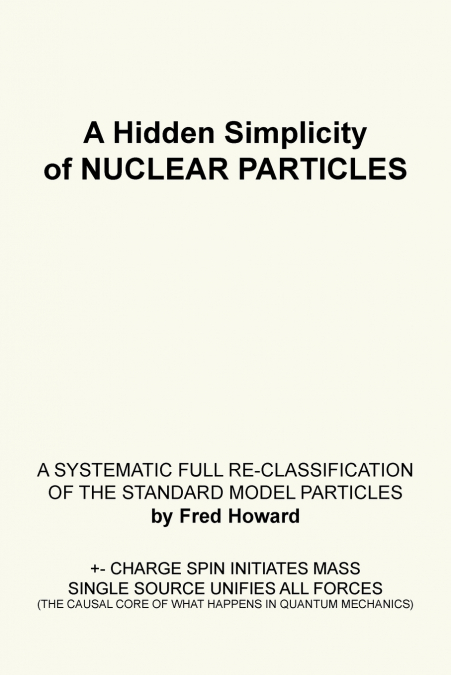
A Hidden Simplicity of Nuclear Particles

A Hidden Simplicity of Nuclear Particles

A Hidden Simplicity of Nuclear Particles

Fred Howard

23,20 €
IVA incluido
Disponible
Editorial:
Xlibris US
Año de edición:
2018
Materia
Física
ISBN:
9781984539755
23,20 €
IVA incluido
Disponible

Selecciona una librería:

  • Librería Samer Atenea
  • Librería Aciertas (Toledo)
  • Kálamo Books
  • Librería Perelló (Valencia)
  • Librería Elías (Asturias)
  • Donde los libros
  • Librería Kolima (Madrid)
  • Librería Proteo (Málaga)

With the expectation of becoming a technical writer on science and technology advances, the author graduated in 1935 (at the height of the Great Depression) from the University of North Carolina with a specially selected set of multiple minors in physics, chemistry, and math. After a few years as a news reporter and commercial fisherman, he returned to graduate school but with a sociology thesis drama that was both produced on campus and carried on tour over two states by the UNC Drama Department while he managed its theatre equipment. (The author lost eighteen pounds and dropped out on the second year of the masters degree.) With the approach of WWII, he returned to physics with electronics classes at VPI, teaching electronics for the Signal Corps, a navy commission and aviation electronics schools in which he became an assistant superintendent of training. In 1950 he transferred as a civil service electronics engineer to a USAF radar and weapons testing and research unit, where he became first the head of plans and program and later of advanced concepts research in electronic detonation phenomena and consequent new warhead design. When the USAF reviewed this progress and decided officially to stay in non-nuclear weapons R & D, and a new lab division was established to continue his personal research. He soon retired in 1983 but could not stop research on the problem that the electron particle could not be defined beyond worldwide description as a mathematical point with no known structure.That is resolved here with the authors discovery of a new fifth power law of particle mass and energy, which greatly simplifies and restructures all of last centurys standard model of subatomic particles, with new foundational emphasis on the structures of the electron, the hadron quarks, dark matter neutrinos, and the photon. This is defined here at the college sophomore level of overview for survey courses and the advanced general reader about particle physics and also for continued development in postgraduate math over the new century, just as what occurred to provide the last centurys excessively complex standard model of all the known particles. This core power law is based on reanalysis of the biennially updated accredited international Particle Data Group data tables provided for world use by US Lawrence Berkeley Lab. This foot-thick printed data table volume is usually used from the internet at PDG.LBL.gov. It is downloaded by page or section as desired worldwide. This new particle book required two decades of research after the discovery and publication of the fifth power law in the 2005, in issue 3 of the Florida Scientist journal of the Florida Academy of Sciences, in which the author is a life member, as he is also in the American AAAS. He is also a past section chairman of IEEE (then IRE).
Artículos relacionados

  • INT’L PHYSICS OLYMPIADS (B/H)
    GORZKOWSKI W / W GORZKOWSKI
     This volume is the first international collection of the best physics problems (both theoretical and experimental) given at the national physics competitions for high school students in different countries. The book introduces the short history of the International Physics Olympiad, the Statutes, the Syllabus, the statistical data including complete list of winners and a colle...
  • EVERYDAY PHYSICS
    HOVE MICHEL A VAN / MICHEL A VAN HOVE
    This book aims to popularize physics by emphasizing conceptual ideas of physics and their interconnections, while avoiding mathematics entirely. The approach is to explore intriguing topics of daily relevance by asking and discussing questions: thereby the reader can participate in developing answers, which enables a deeper understanding than is achievable with memorization.The...
  • Zimányi School
    This reprint includes papers that were presented at the Zimányi School Winter Workshop in 2022. This workshop aimed to summarize the developments of 2022 in high-energy heavy-ion physics with particular attention to the new data emerging from the Relativistic Heavy Ion Collider (RHIC), the Large Hadron Collider (LHC) and SPS. The included papers discuss new results in hydrodyna...
  • Advances in Quantum Computing
    The field of quantum information science has seen tremendous progress over the last several years, with advances in both hardware development and novel algorithms. This Special Issue has endeavored to capture some of the technical advances in this rapidly changing field. ...
  • An Introduction to Materials Science
    Héctor L. Mancini / Wenceslao González-Viñas
    Materials science has undergone a revolutionary transformation in the past two decades. It is an interdisciplinary field that has grown out of chemistry, physics, biology, and engineering departments. In this book, González-Viñas and Mancini provide an introduction to the field, one that emphasizes a qualitative understanding of the subject, rather than an intensely mathematica...
  • FUNDAMENTALS OF EQUATIONS OF STATE
    Ajoy Ghata / AJOY GHATAK & ET AL SHALOM ELIEZER / ELIEZER SHALOM / Heinrich Hora / Shalom Eliezer
    The equation of state was originally developed for ideal gases, and proved central to the development of early molecular and atomic physics. Increasingly sophisticated equations of state have been developed to take into account molecular interactions, quantization, relativistic effects, etc.Extreme conditions of matter are encountered both in nature and in the laboratory, for e...

Otros libros del autor

  • A Hidden Simplicity of Nuclear Particles
    Fred Howard
    With the expectation of becoming a technical writer on science and technology advances, the author graduated in 1935 (at the height of the Great Depression) from the University of North Carolina with a specially selected set of multiple minors in physics, chemistry, and math. After a few years as a news reporter and commercial fisherman, he returned to graduate school but with ...
  • Headlong Into Quicksand
    Fred Howard
    ...
  • Headlong Into Quicksand
    Fred Howard
    ...
    Disponible

    19,87 €