 Librería Samer Atenea
 Kálamo Books
 Librería Elías (Asturias)
 Librería Kolima (Madrid)
 Librería Proteo (Málaga)
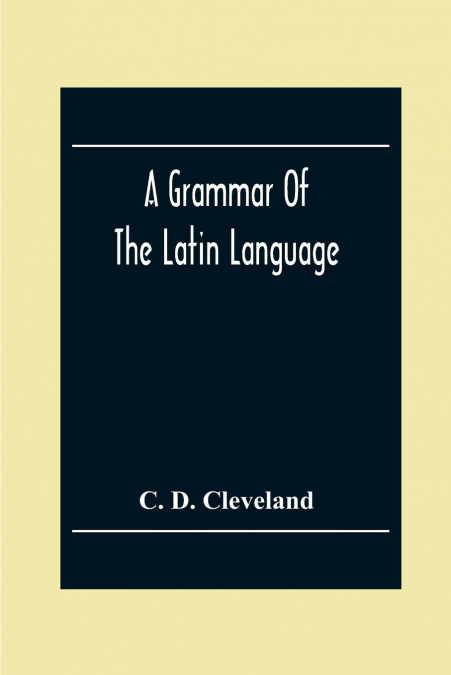
A Grammar of the Latin Language, on the basis of the Grammar of Dr. Alexander Adam (Edinburgh), offers a disciplined, lucid handbook for anyone serious about classical language study. Essential rules for disciplined reading. D. Cleveland adapts Adam’s method into a practical latin grammar textbook that balances explanation with examples. Its organised chapters map latin syntax and morphology so learners apprehend declensions and verb patterns with assurance. As a latin language reference and a comprehensive latin course in miniature, it supports translation, composition and close reading alike, and suits both classroom use and independent latin language self-study.Rooted in nineteenth century linguistics, the text preserves the straightforward pedagogy of the Dr Alexander Adam grammar while given a practical shape by D. Cleveland. As a latin declensions guide and a clear manual of latin verb conjugations, it lays out syntax and morphology with economy and rigour; technical detail is steady but never obscure, making it valuable both as a latin language reference and as support for students of classical languages. Republished by Alpha Editions in a careful modern edition, this volume preserves the spirit of the original while making it effortless to enjoy today - a heritage title prepared for readers and collectors alike. It suits casual readers drawn to classical texts as much as classic-literature collectors who prize historical language instruction and considered production, and it rewards study, quiet curiosity and reference in equal measure.Measured, clear and historically mindful, the grammar makes the conventions of Latin tangible: paradigms become tools rather than obstacles, and subtle syntactic choices are explained in human terms. It suits teachers preparing lessons and independent students who pursue latin language self-study, offering a dependable reference for translation practice and textual appreciation. Collectors of nineteenth century works and classic-literature anthologies will find value in the book’s faithful pedagogy and considered presentation, while casual readers interested in classical language study can use it as an approachable companion on their first readings of Latin authors. Practical, restrained and precise, this edition rewards steady attention and thoughtful use.