Inicio > > Ciencias de la computación > A Computer-Assisted Analysis System for Mathematical Programming Models and Solutions
A Computer-Assisted Analysis System for Mathematical Programming Models and Solutions

A Computer-Assisted Analysis System for Mathematical Programming Models and Solutions

H.J. Greenberg

206,36 €
IVA incluido
Consulta disponibilidad
Editorial:
Springer Nature B.V.
Año de edición:
1993
Materia
Ciencias de la computación
ISBN:
9780792393221

Selecciona una librería:

  • Librería Samer Atenea
  • Librería Aciertas (Toledo)
  • Kálamo Books
  • Librería Perelló (Valencia)
  • Librería Elías (Asturias)
  • Donde los libros
  • Librería Kolima (Madrid)
  • Librería Proteo (Málaga)

Welcome to ANALYZE, designed to provide computer assistance for analyzing linear programs and their solutions. Chapter 1 gives an overview of ANALYZE and how to install it. It also describes how to get started and how to obtain further documentation and help on-line. Chapter 2 reviews the forms of linear programming models and describes the syntax of a model. One of the routine, but important, functions of ANALYZE is to enable convenient access to rows and columns in the matrix by conditional delineation. Chapter 3 illustrates simple queries, like DISPLAY, LIST, and PICTURE. This chapter also introduces the SUBMAT command level to define any submatrix by an arbitrary sequence of additions, deletions and reversals. Syntactic explanations and a schema view are also illustrated. Chapter 4 goes through some elementary exercises to demonstrate computer­ assisted analysis and introduce additional conventions of the ANALYZE language. Besides simple queries, it demonstrates the INTERPRT command, which automates the analysis process and gives English explanations of results. The last 2 exercises are diagnoses of elementary infeasible instances of a particular model. Chapter 5 progresses to some advanced uses of ANALYZE. The first is blocking to obtain macro views of the model and for finding embedded substructures, like a netform. The second is showing rates of substitution described by the basic equations. Then, the use of the REDUCE and BASIS commands are illustrated for a variety of applications, including solution analysis, infeasibility diagnosis, and redundancy detection.

Artículos relacionados

Otros libros del autor

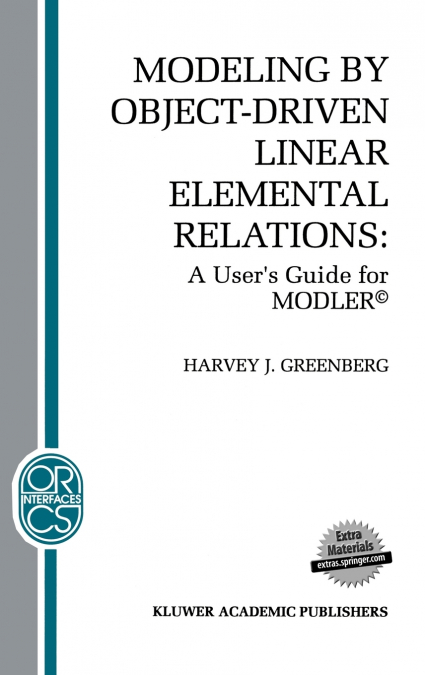
  • Modeling by Object-Driven Linear Elemental Relations
    H.J. Greenberg
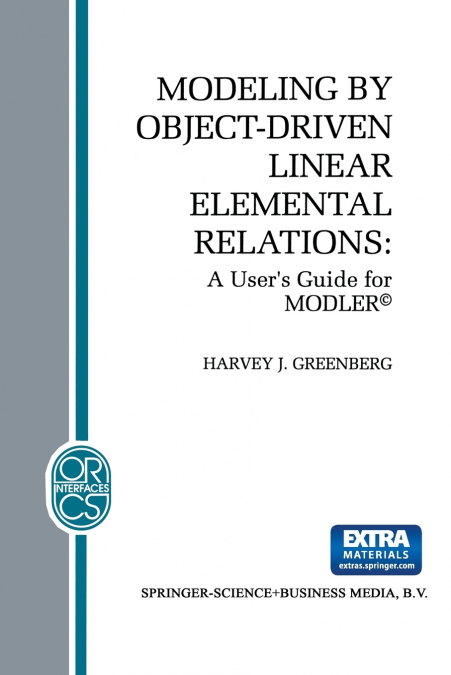
    Modeling by Object-Driven Linear Elemental Relations (MODLER) is a computer language for representing linear programming models, completely separate from instances defined by data realizations. It also includes representations of binary variables and logical constraints, which arise naturally in large-scale planning and operational decision support. The basic input to MODL...
    Disponible

    48,38 €

  • Modeling by Object-Driven Linear Elemental Relations
    H.J. Greenberg
    Modeling by Object-Driven Linear Elemental Relations (MODLER) is a computer language for representing linear programming models, completely separate from instances defined by data realizations. It also includes representations of binary variables and logical constraints, which arise naturally in large-scale planning and operational decision suppo...
    Disponible

    208,24 €

  • Modeling by Object-Driven Linear Elemental Relations
    H.J. Greenberg
    Modeling by Object-Driven Linear Elemental Relations (MODLER) is a computer language for representing linear programming models, completely separate from instances defined by data realizations. It also includes representations of binary variables and logical constraints, which arise naturally in large-scale planning and operational decision suppo...