
Inicio > Derecho > Derecho internacional > A Collective Theory of Genocidal Intent
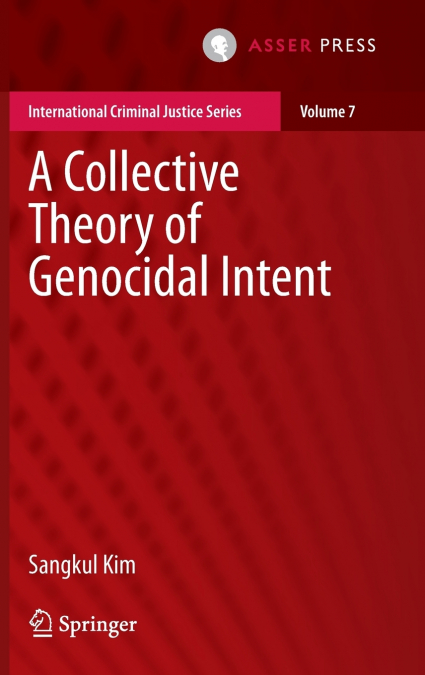
A Collective Theory of Genocidal Intent

A Collective Theory of Genocidal Intent

Sangkul Kim

194,25 €
IVA incluido
Consulta disponibilidad
Editorial:
Springer Nature B.V.
Año de edición:
2016
Materia
Derecho internacional
ISBN:
9789462651227

Selecciona una librería:

  • Librería Samer Atenea
  • Librería Aciertas (Toledo)
  • Kálamo Books
  • Librería Perelló (Valencia)
  • Librería Elías (Asturias)
  • Donde los libros
  • Librería Kolima (Madrid)
  • Librería Proteo (Málaga)

Tackling one of the most confusing and controversial issues in the field of international criminal law - i.e., the genocidal intent element, this monograph seeks to develop an account of genocidal intent from a collectivist perspective. Drawing upon the two-layered structure of the crime of genocide composed of the ’conduct level’ and ’context level’, it detects the genocidal intent element at the ’context level’. The genocidal intent found in this manner belongs to a collective, which significantly departs from the prior individualistic understandings of the notion of genocidal intent. The author argues that the crime of genocide is not a ’crime of mens rea’. Collective genocidal intent at the ’context level’ operates in a way that renders the crime of genocide itself a criminal enterprise. The idea of genocide as a criminal enterprise also suggests that genocide is a leadership crime in respect of which only the high-level actors can be labeled as principals (as opposed to accessories). The book criticizes the dominant individualistic approaches to genocidal intent (in particular: the knowledge-based approach) which have thus far governed the relevant jurisprudential and academic analysis. It further demonstrates that the hidden notion of ’collective genocide’ silently governs the relevant international jurisprudence. Practitioners and academics in the field of international criminal law and related disciplines will find in this book a new approach to the crime of genocide. The text is the first-ever book-length exposition of a collective account of genocidal intent. Its accessibility is highly enhanced by relevant footnotes.Sangkul Kim is Lecturer at Korea University in Seoul and Research Fellow with the Centre for International Law Research and Policy (CILRAP).He served as Associate Legal Adviser at the Office of the Prosecutor of the International Criminal Court (2004-2008). He earned law degrees from Korea University and Georgetown University Law Center.
Artículos relacionados

  • Comparative regulation, economic analysis, and applications of private equity in the united states and european union
    Irini Liakopoulou
    The present work examines the economics and legal doctrine of private equity. After a consideration of private equity’s origins, the book will explore the evolution of private equity in the United States and Europe. The reference economic model then will be reconstructed, with particular attention to financial flows to and from private equity firms and funds. This reconstructio...
  • Complicity in International Law
    Dimitris Liakopoulous
    Complicity in International Law aims to analyze questions arising from a state’s complicity in conflict with another state or an international organization. On the basis of international legal provisions, a state that assists the illicit fact of another state or an international organization in turn commits an offense if it is aware of the main fact and is bound by the same obl...
  • Command responsibility
    James B Whisker / Kevin R Spiker
    Command responsibility, or executive accountability, assumes that leaders are responsible for the actions of their subordinates. If subordinates misbehave, violate basic moral laws, transgress international law, or thwart international standards of behavior, their leader may be called before to justice. Standards that set the boundaries of human action have been evolving for ma...
  • International Organizations and Reparations
    Dimitris Liakopoulos
    In the first part of this book, noted legal scholar Dimtris Liakopoulos deals with reconstructing the legal regulatory framework governing human rights violations in the activities of organizations. After identifying rules that are generally applicable to organizations’ offenses and govern the profile of reparations, this study assesses primary rules that guarantee the right to...
  • International Organizations and Legal Sanctions Against Governments
    Dimitris Liakopoulos
    This book examines the relationship between governments and international organizations under international law. After surveying the policing powers of international organizations under international law, it illustrates some normative aspects of law that distinguish regulation from enforcement via study of recent legal cases before international judicial bodies. According to Di...
  • The EU Foreign Subsidies Regulation
    Andreas Reindl / Isabelle Van Damme
    'The EU Foreign Subsidies Regulation' is a pioneering manual authored by legal experts Andreas Reindl and Isabelle Van Damme. This essential guide, the first of its kind, is tailored for legal practitioners, offering a thorough exploration of the tools and mechanisms embedded within this novel European regulatory framework. The authors meticulously dissect the EU Foreign Subsid...