
Inicio > Medicina > Medicina clínica e interna > Medicina musculoesquelética > A Biomechanical and Morphological Analysis of Human Hand Joints
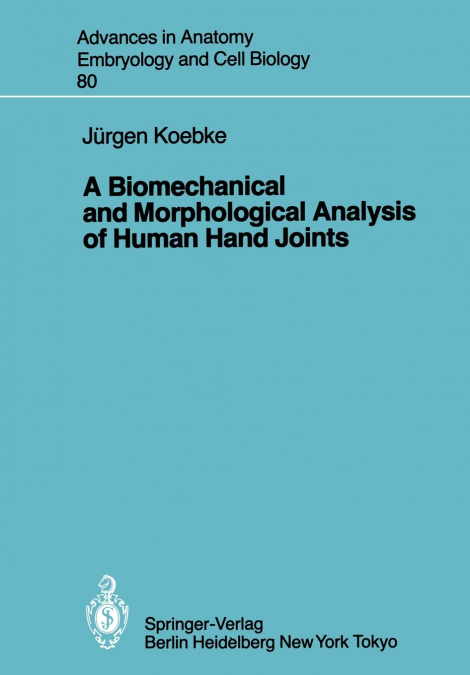
A Biomechanical and Morphological Analysis of Human Hand Joints

A Biomechanical and Morphological Analysis of Human Hand Joints

J. Koebke

66,98 €
IVA incluido
Disponible
Editorial:
Springer Nature B.V.
Año de edición:
1983
Materia
Medicina musculoesquelética
ISBN:
9783540124382
66,98 €
IVA incluido
Disponible

Selecciona una librería:

  • Librería Samer Atenea
  • Librería Aciertas (Toledo)
  • Kálamo Books
  • Librería Perelló (Valencia)
  • Librería Elías (Asturias)
  • Donde los libros
  • Librería Kolima (Madrid)
  • Librería Proteo (Málaga)

Functional morphology seeks to establish the relationship between form and function: the description of anatomic phenomena is used as a basis for defining functional factors which themselves, long term, affect the development of the form. This kind of basic study is essential for our understanding of quadruped and human motion and has been discussed by Pauwels (1948,1955, 1960) and Kummer (1956, 1959, 1962, 1978). Biomechanical analysis of human upper and lower limb joints has resulted in causal therapy in cases of joint disease (Pauwels 1935, 1961, 1976; Maquet 1976). Studies of the functional strain on the shoulder joint socket and the elbow joint have been carried out by Pauwels (1955, 1959, 1963) and Tillmann (1971, 1978). Joints of the human hand and wrist have been discussed from a phylogenetic, onto­ genetic, anatomic-descriptive, and clinical point of view (Thilenius 1895; Corner 1898; Zrubecky 1960; Lewis 1970; Blauth and Schneider-Sickert 1976; et al.), but so far no studies of these joints have been undertaken with a view to investigating the functional connection between morphology and specific strain. This study aims to establish the relationship between the form and the normal or disturbed functioning of three important joints of the human hand: the proximal wrist joint, the saddle joint of the thumb, and the metacarpophalangeal joints, and to evaluate the findings biomechanically and clinically.
Artículos relacionados

  • The Parents’ Guide to Children’s Orthopaedics (Arabic)
    Ellie Walker / Ruth Farrell / Sattar Alshryda
    دليل ألوالدين لجراحة عظام ألأطفال هو عبارة عن سلسلة من الكتيبات الصغيرة عن مشاكل عظام ومفاصل ألأطفال التي غالبا ما تقلق الآباء والأمهات. تم كتابة كل كتيب بالاشتراك مع الوالدين والأطفال ومقدمي الرعاية الصحية من مختلف التخصصات لتعميق معرفة الأباء وألأمهات حول مشكلة أبنائهم بحيث يمكن أن يسهمو بشكل فعال في العلاج. تم الرد على الأسئلة المتداولة في لغة الشخص العادي وتم شرح المصطلحات ...
    Disponible

    16,21 €

  • Enfoque del trauma ortopédico
    Uribe Ríos Alejandro
    ’El objetivo del libro es brindar conceptos básicos al momento de enfrentarse a lesiones ortopédicas secundarias a traumas, inicia desde la sospecha y aproximación de las lesiones dependiendo del mecanismo del trauma, evaluación mediante inspección, estabilización, maniobras y exámenes complementarios; también da conceptos sobre los diferentes tratamientos médicos y quirúrgicos...
    Disponible

    16,59 €

  • Skeletal Function and Form
    Dennis R. Carter / Dennis RCarter / Gary S. Beaupre / Gary SBeaupre
    ...
  • Orthopaedic Emergencies
    Casey Jo Humbyrd
    ...
    Disponible

    118,91 €

  • The Brittle Bone Disease Mastery Bible
    Dr. Ankita Kashyap / Prof. Krishna N. Sharma
    'The Brittle Bone Disease Mastery Bible: Your Blueprint for Complete Brittle Bone Disease Management' is an empowering and comprehensive guide that sheds light on the intricacies of brittle bone disease, providing valuable insights for both patients and caregivers. From unraveling the historical perspective and genetic factors to exploring the various types and diagnosis proced...
    Disponible

    14,77 €

  • Animal Models in Orthopaedic Research
    ...