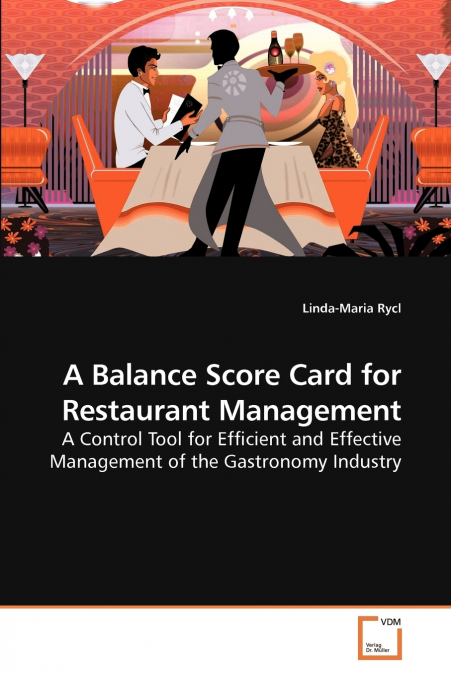

A Balance Score Card for Restaurant Management

A Balance Score Card for Restaurant Management

Linda-Maria Rycl

60,43 €
IVA incluido
Disponible
Editorial:
KS OmniScriptum Publishing
Año de edición:
2010
ISBN:
9783639225143
60,43 €
IVA incluido
Disponible

Selecciona una librería:

  • Librería Samer Atenea
  • Librería Aciertas (Toledo)
  • Kálamo Books
  • Librería Perelló (Valencia)
  • Librería Elías (Asturias)
  • Donde los libros
  • Librería Kolima (Madrid)
  • Librería Proteo (Málaga)

A restaurant’s success depends on many different factors of influence which can be summarized in four segments, the product, the place, the price and the promotion of a restaurant. Therefore, a successful restaurant concept needs to determine its product appearance as e.g. the qualification and productivity of its employees. It also has to consider the restaurant’s location factors, the given room arrangement, the price - quality spectrum as well as its image in order to convince customers of the restaurant’s concept, thus generating sustainable success. In practice, many restaurants exhibit a huge amount of significant defects, leading to failure or even to bankruptcy of the business. The defects emerge at different levels of operation as e.g. through unmotivated employees. The Balance Score Card (BSC) for restaurants is created to counteract the defects and provide information for future decisions. Therefore, by implementing a BSC, the restaurant’s management obtains a managing and control instrument, helping to analyze historical strategies and to develope current and future strategies.

Artículos relacionados

  • Technological Change and the British Iron Industry, 1700-1870
    Charles K. Hyde
    This book describes technological change in an industry that played a central role in the Indsutrial Revolution. While earlier scholars have examined isolated aspects of ironmaking in the eighteenth- and nineteenth-century Britain, Charles Hyde surveys all aspects of its development. Costs, prices, profits, shrewd leaders, competition, new inventions, and productivity all figur...
    Disponible

    71,94 €

  • Corporate Governance in Asia
    ...
    Disponible

    72,99 €

  • The European Guilds
    Sheilagh Ogilvie
    A comprehensive analysis of European craft guilds through eight centuries of economic historyGuilds ruled many crafts and trades from the Middle Ages to the Industrial Revolution, and have always attracted debate and controversy. They were sometimes viewed as efficient institutions that guaranteed quality and skills. But they also excluded competitors, manipulated markets, and ...
  • Technological Change and the British Iron Industry, 1700-1870
    Charles K. Hyde
    This book describes technological change in an industry that played a central role in the Indsutrial Revolution. While earlier scholars have examined isolated aspects of ironmaking in the eighteenth- and nineteenth-century Britain, Charles Hyde surveys all aspects of its development. Costs, prices, profits, shrewd leaders, competition, new inventions, and productivity all figur...
  • Technology Differences over Space and Time
    Francesco Caselli
    Technology Differences over Space and Time looks at how countries use their productive resources-such as workers, skills, equipment and structures, and natural resources. Francesco Caselli develops methods to assess the efficiency with which productive inputs are used, and how these efficiencies vary across countries and over time.Caselli finds that richer countries use skilled...
  • Cybersecurity Measures for Logistics Industry Framework
    Global supply chains are becoming more customer-centric and sustainable thanks to next-generation logistics management technologies. Automating logistics procedures greatly increases the productivity and efficiency of the workflow. There is a need, however, to create flexible and dynamic relationships among numerous stakeholders and the transparency and traceability of the supp...