 Librería Samer Atenea
 Kálamo Books
 Librería Elías (Asturias)
 Librería Kolima (Madrid)
 Librería Proteo (Málaga)
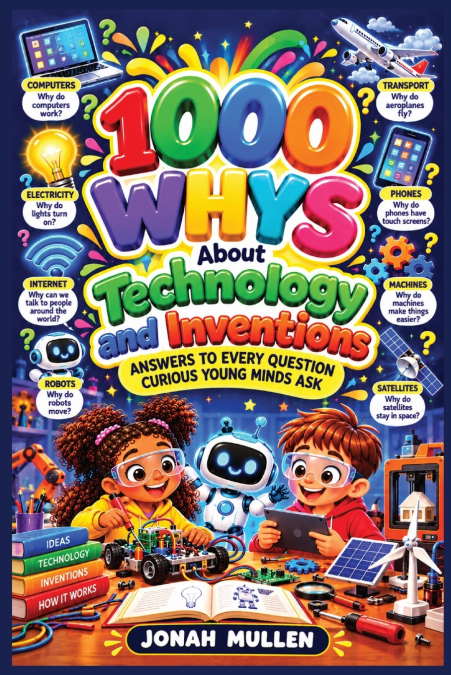
A full-color visual encyclopedia for kids who can’t stop asking how things work.Most kids’ technology books show a few famous machines, add a caption and move on. This book is different. It answers 1,000 real questions children actually ask about inventions and the technology all around them. Every answer is numbered, short and clear, and each one comes with bright, full-color illustrations. Kids explore alongside Ada and her robot friend Bolt, who have already tracked down every answer.Why can a bird sit on a power line without getting a shock? How does a touchscreen know exactly where your finger is? Why is the word on the front of an ambulance written backwards? How does a toilet know when to stop filling? Why can a maglev train go faster than any train on wheels?It’s designed for curious readers ages 4 to 12 who want to understand how things work and where they came from, not just what they’re called.Inside, kids will explore 12 inventive worlds:Before Machines: stone tools, fire, mud bricks, and how people got anything done before engines existedThe Inventions That Changed Everything: the printing press, the steam engine, the microchip, and what the wheel was really used for firstHow Your House Works: boilers, light bulbs, cavity walls, banging pipes, and the float that tells your toilet when to stopElectricity and Power: batteries, power stations, solar panels, and why birds can perch on power linesScreens and Computers: touchscreens, ones and zeros, how 'undo' remembers your mistakes, and why computers freezeThe Internet: who invented the World Wide Web, what lives inside a data center, and how a message finds its way around the worldPhones and Signals: text messages, GPS maps, weak signals in elevators, and millions of calls squeezed into one cable under the seaGetting Around: car engines, bicycles that stay upright, airplane wings, racing car spoilers, and super-fast maglev trainsBuilding Big: the tallest building on Earth, cranes that climb skyscrapers, and buildings that bend in earthquakesFactories and How Things Are Made: conveyor belts, robot arms, 3D printers, and why some things are still made by handMedicine and Machines: hearing aids, surgical robots, brain scanners, and 3D-printed bonesWhat’s Coming Next: flying cars, robot friends, and whether robots will ever really think for themselvesThis is not a dense engineering manual. It is not a picture book with a few captions. It’s a colorful, surprising tour through the questions kids naturally ask about the machines and inventions that shape their everyday lives.Open any page and start with one question. By the end, your child may know more about how the world works than the grown-ups around them.